 Portal Login
Earth Day always comes with a familiar rhythm: campaigns, panels, posts, pledges. It’s a moment of reflection that brings environmental awareness to the forefront of global conversation.
But over time, I’ve come to see a gap between reflection and reality.
Climate change is often discussed in abstract terms: emissions targets, temperature thresholds, policy frameworks. Yet the more time I’ve spent working in sustainability education and designing immersive learning experiences, the clearer it becomes that climate change is not just something we understand intellectually. It’s also something we have to experience, at least in part, to truly understand it and grasp its complexity.
Earth Day sparks awareness, but lasting impact requires rethinking how we educate people about climate change. By moving beyond the classroom and into real-world experiences, climate education can better prepare individuals to understand complexity and drive meaningful action.
When Climate Becomes Personal
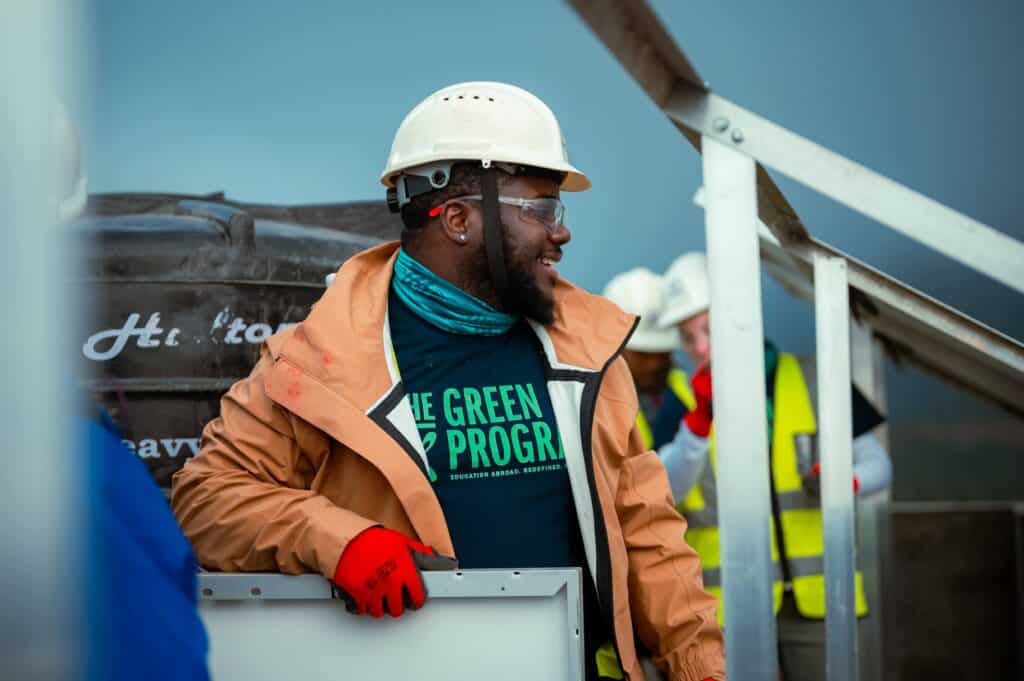
Over the past sixteen years, I’ve watched students and professionals encounter climate change for the first time not through a textbook, but through place—standing in environments where the impacts are visible, measurable, visceral, and immediate.
In those moments, something shifts.
A glacier retreating over decades is no longer just a data point. A community gaining access to reliable renewable energy systems is no longer just a case study. These become real systems, shaped by policies, tradeoffs, constraints, and human decisions.
Climate change stops being distant and starts becoming personal.
And that personal connection changes the way people ask questions. Instead of “What is happening?” the questions become: Who is affected? What does resilience look like here? Who has and has not historically had access to resources, decision-making power, and protection? How can my role and my studies realistically support long-term, equitable solutions in this context?
Those are fundamentally different starting points for learning.
The Role of Proximity in Understanding Complexity
One of the most consistent patterns I’ve observed is how proximity (being physically and contextually close to a problem) reshapes understanding.
When learners engage directly with communities, infrastructure, and ecosystems impacted by climate change, they begin to see how interconnected everything is. Energy systems are not isolated from policy. Community resilience is not separate from economics. Environmental outcomes are tied to decisions made across sectors and scales.
This kind of understanding is difficult to replicate in a purely classroom-based environment.
Textbooks and lectures are essential for building foundational knowledge. But proximity introduces nuance. It reveals constraints, tradeoffs, and lived realities that are often missing from simplified models of the world. It also creates the opportunity to speak directly with the people and communities living these realities—learning from local practitioners, community leaders, and stakeholders who are navigating these challenges and developing solutions firsthand.
And for many students, it is this combination of knowledge plus experience that begins to define their sense of purpose within sustainability.
Bridging Theory and Real-World Application
Across experiential learning environments, I’ve seen a recurring theme: participants start to connect what they’ve learned academically to what they observe in real time.
Concepts like energy transition, climate finance, or sustainable infrastructure become more concrete when they are encountered in practice, through site visits, conversations with practitioners, or exposure to ongoing projects.
In many cases, this is where career direction begins to take shape.
Participants who may have previously understood sustainability in broad terms start to identify specific pathways—whether in renewable energy systems, environmental policy, corporate sustainability, or development work. The learning becomes not only intellectual, but directional.
Alumni often describe these experiences as pivotal, not because they provide all the answers, but because they clarify the questions. Participants leave with a better sense of where they want to contribute and what kind of work aligns with both their skills and values.
This matters at a systems level. Nearly 50% of the global workforce lacks the skills required for their roles, and 58% of employers report that recent graduates are not workforce-ready. At the same time, green jobs are projected to grow rapidly while outpacing the supply of trained professionals, signaling a widening skills gap across sustainability sectors. These trends highlight a structural disconnect between traditional education models and the realities of the evolving workforce.
Experiential learning helps bridge that gap by translating knowledge into applied understanding—developing not only subject-matter familiarity, but also the adaptability, systems thinking, and real-world exposure that sustainability careers demand.
Rethinking What It Means to Be “Educated” in Sustainability
Working in this space has challenged my assumptions about what effective education looks like.
There is immense value in academic rigor, research, and structured learning. But when it comes to complex global challenges like climate change, education benefits from moving beyond observation into participation.
This is particularly relevant in a world where approximately 40% of workforce skills are expected to become outdated by 2030, and where a majority of employers increasingly prioritize hands-on, applied experience when evaluating talent. In this context, experiential learning is not supplementary; it is increasingly essential. For example, a student who studies renewable energy systems in a classroom may understand the technical principles of solar deployment, but through an immersive field experience such as visiting a working solar installation, speaking with local engineers and operators, and analyzing real performance and grid constraints, they gain a more applied understanding of how those systems function in practice. That exposure not only reinforces technical knowledge but also builds practical skills, contextual awareness, and professional readiness that are difficult to develop through theory alone.
Experiential learning doesn’t replace traditional education; however, it complements it by adding context, relevance, and lived experience.
It allows individuals to:
- See how systems operate in real-world conditions
- Understand the interdependence of environmental, social, political, and economic factors
- Engage with practitioners and communities directly
- Apply theoretical frameworks in dynamic environments
Over time, this approach doesn’t just build knowledge. It builds perspective.
Beyond Symbolism
Earth Day serves an important role in raising awareness and creating shared moments of reflection. But the scale of the climate challenge requires something more continuous, more embedded, and more experiential.
Awareness is a starting point. Understanding deepens when it is grounded in real-world context. And meaningful action is more likely to emerge when individuals have engaged directly with the complexity of the systems they are trying to influence.
For me, the most impactful learning has always come from proximity—from being close enough to observe, to ask questions, to listen, and to truly connect on a human level. That belief was a core reason I started The GREEN Program: to create opportunities where learners could move beyond the classroom and engage directly with the places, people, and systems shaping the future of sustainability. Over time, I found that others shared this same intuition that meaningful understanding deepens when education is grounded in a real-world context and lived experience.
That proximity changes how we see problems.
And when our understanding changes, so does our ability to respond.