 Portal Login
Darrell Everett Patterson Jr.
Senegal 2026
Green Innovation, Climate Finance, & Historic Reflection
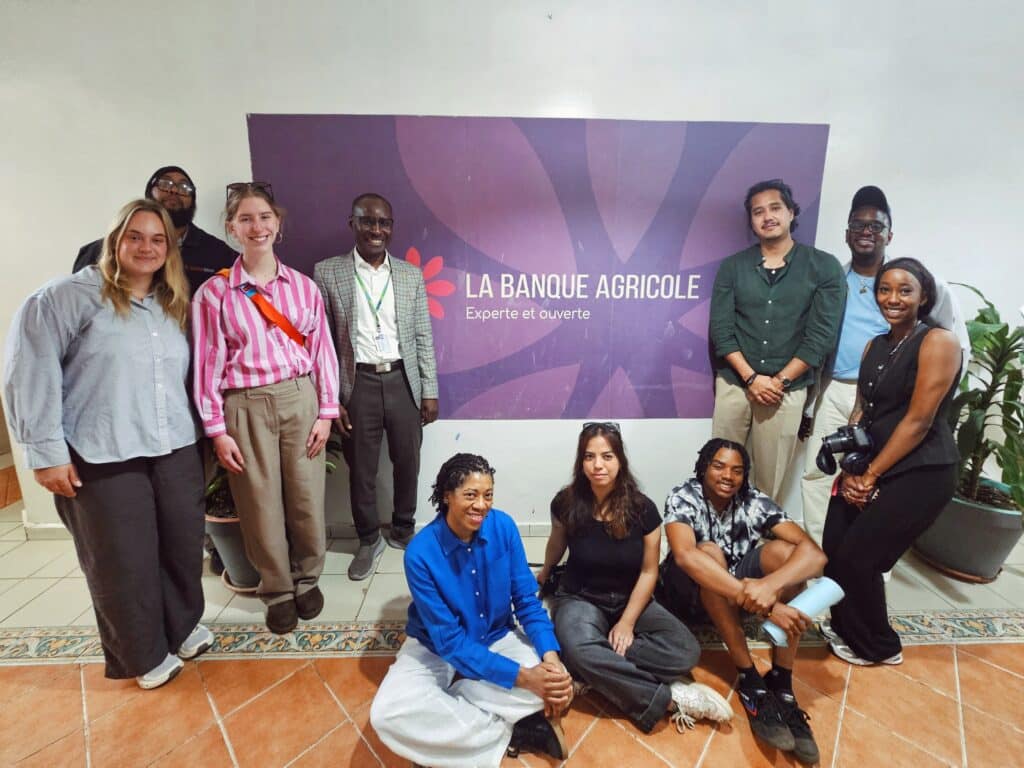
Green innovation can be defined as “using new production technologies that help reduce environmental risks and create an atmosphere to use resources effectively” (Danish, Hua & Bhutta, pg. 4, 2024). During The Green Program (TGP)’s visit to La Banque Agricole, I learned firsthand how green innovation and climate finance are being actively deployed to support economic development in Senegal. As an agency devoted to spurring economic growth through agriculture, fishing, and livestock farming in West Africa, La Banque Agricole plays a pivotal role in agroeconomics and forest engineering, operating through environmental, social, and governance
(ESG) policies and climate finance. The organization’s mission is to produce and commercialize agricultural products from smallholder farmers, small and medium enterprises (SMEs), and industrial-scale agricultural farm operations. Through financing at each stage of market activity – production of agricultural products, storing and management of inventory, and commercial distribution – around $35 billion (francs) is leveraged from La Banque Agricole to support smallholder farmers and agricultural industrial development annually. Green innovation serves as a mechanism that enables the mitigation of impacts that stem from global climate change and the phenomenon itself, as energy efficiency through solar-powered pumps provides a cost-effective approach for irrigation compared to conventional diesel-powered pumps, which are more costly. Biogas and organic fertilizer are amongst complementary green innovations that drive climate finance through farmer production processes. Understanding that sustainable management of produced goods is mission-critical to the preservation of commodities and long-term value creation from arable farmlands, the work that Le Banque Agricole performs can be viewed as a cornerstone economic development building-block necessary to sustain the livelihoods of Senegalese people and beyond.
TGP’s visit to Proplast Industrie sheds light on how plastic waste can be recovered, remanufactured, and reused for purposeful utility in developing countries. I was able to witness key production processes including gathering and sorting, cleaning and selection, melting into solid slabs, and machine-driven cutting of plastic slabs into whole and puzzle pieces that merged to combine whole constructs. Given that 125 francs per kilogram of plastic is awarded to those who recycle and redeem their plastic waste, Proplast Industrie provides a source of economic payment for ecosystem services (PES) – albeit technical, and not biological nutrients – that drives economic growth amongst poorer communities that often are comprised of inadequate waste management services. Key constructs that were produced from these economic activities include mobile phone stands, chairs, tables, desks, and whole plastic slabs that can be used in construction projects.
Pink Lake Exploration & Bandia Safari Adventure
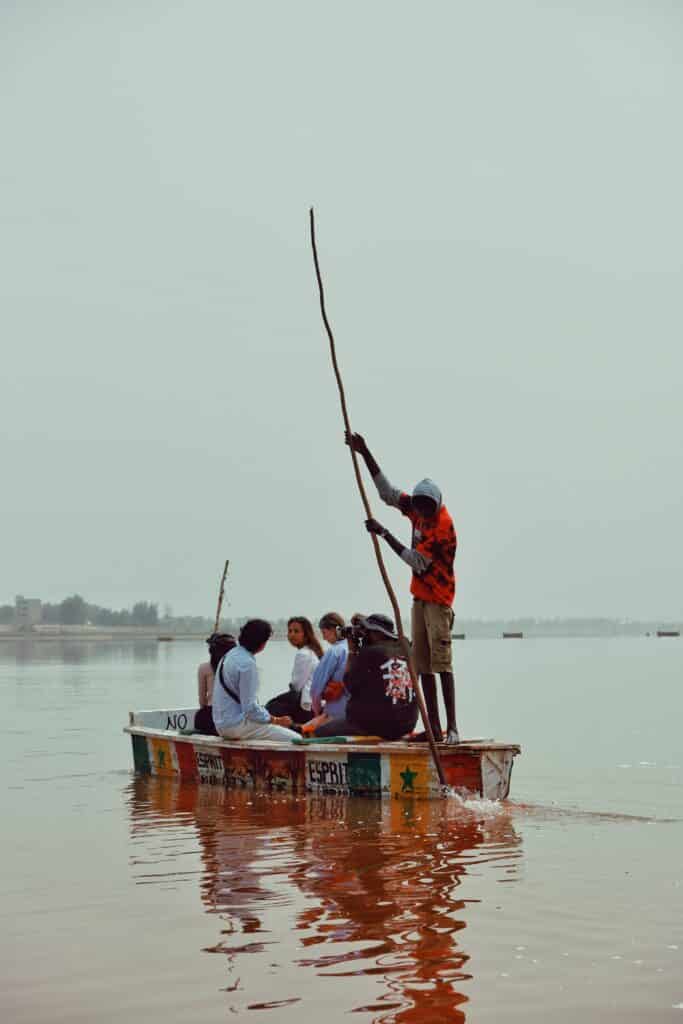
Lac Rose, also known as the Pink Lake, was by far one of the most ecologically and economically compelling visits during TGP’s excursion in Senegal, Dakar, and Saly. The lake’s rose-golden, pink color is derived from algae and bacteria species that live and interact within the aquatic ecosystem, combined with the probability of a day of sunshine providing visible light that makes contact with surface waters. Rich in salt deposits, Lac Rose provides a source of economic growth through salt harvesting that occurs 9 months out of the year, due to a 3-month intermittency that coincides with the rainy season. What is most unique about this site visit is that I became aware of a nearly symbiotic human-environmental relationship dynamic, where the preservation of lake waters is enhanced by humans extracting salt from its subsurface, which reduces the rate of evaporation amongst the aquatic ecosystem. Salt is harvested and sent abroad for refinement, where iodine and additional elements are added for purposes intended, such as table salt for consumption. Salt, once refined, is sold back to Senegal at a higher overall value – given the additive production process and transportation costs embedded in post extraction production processes – creating a means for Senegalese people to obtain and consume nutritional elements mission-critical for human, developmental growth. The lake was once 15 square kilometers, and is now 9 as of 2026, largely due to impacts from global climate change. Thankfully, ground and ocean water replenish the lake with fresh and salt water, and the depth of brackish – mostly salt water – asserts a boundary against fresh water that exists 1-2m meters underground. During the dry, 9-month season, salt concentrations of Lac Rose exhibit the highest levels in the world, at 380 grams of salt per liter of water. Salt from the pink lake sells for around $1,500 – $2,000 francs per 25 kilograms, which is about 3 euros per 25 kilograms.
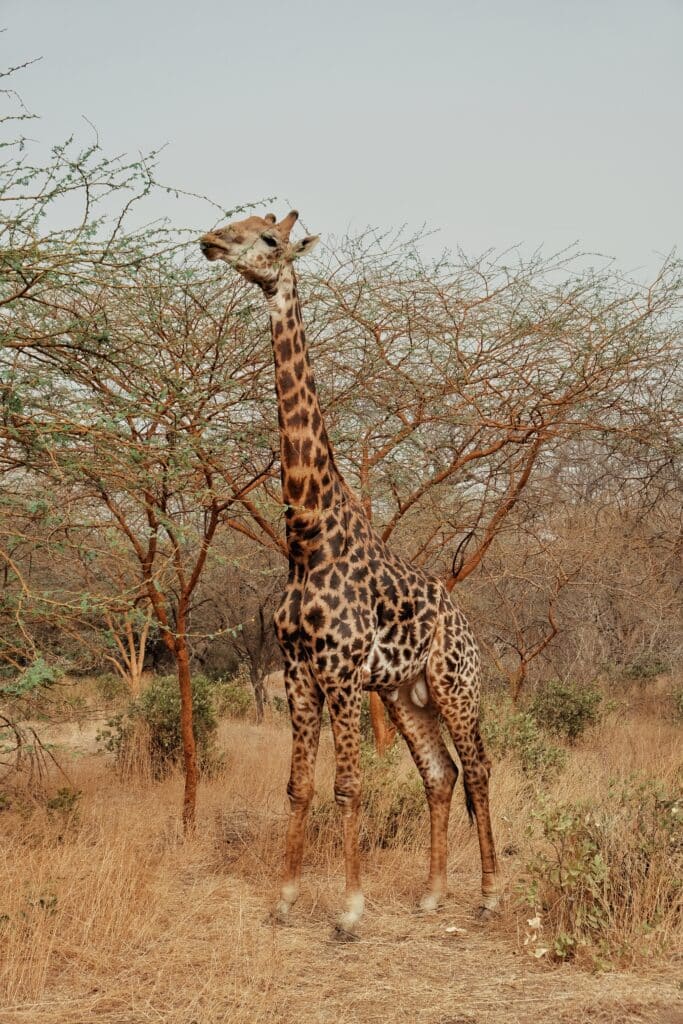
My first trip to Africa made possible through TGP brought me within meters of wild animals that I had only seen in zoos and National Geographic documentaries and episodes. During my visit to the Bandai Safari, I was able to view giraffes, zebras, red monkeys, ostriches, crocodiles, hyenas, two different antelope species, tortoises, warhogs, rhinoceroses, an Abyssinian Roller, and hornbills (the same species of bird as Zazu from The Lion King). Observing wild animals in their natural habitat, interacting amongst their own and other species within a shared space provided a remarkable account of niche partitioning within an ecosystem, and relationships amongst each species considering their needs from and impacts presented upon their collective habitat.
Sine Saloum Eco-Cruise & Baobab Cultural Immersion
TGP’s visit to the Saloum River Delta featured one of the most vast mangrove forest ecosystems that I’ve yet to encounter. I was able to cruise along the delta via a speedboat that accompanied my fellow field course participants, observing breathtaking views that captivated me from a visual and intrinsic perspective. Mangrove species are not only suitable terrestrial-aquatic habitats that provide space for fish, oysters, and other waterborne species, but also serve as a natural buffer against the attenuation of waves that drive erosion along land surfaces proximate to water, and severe storms that have become more intense and frequent since the exacerbation of global climate change. Local people reinforce the erosion-preventing impact that mangrove forests provide through the use of Eucalyptus tree branches that are woven together, like baskets, which provide a tidal break for waves against island and shore banks. One of our visits within the Saloum River Delta was Shell Island – a place where natives to the biome constructed the waterfront edges of the island from actual seashells. Understanding how critical mangrove forests are to blue carbon sequestration efforts and climate change adaptation, it was amazing to see how seagrasses undergirded the semi-aquatic species to provide an enhanced, whole ecosystem approach to carbon sequestration, erosion prevention, and the provisioning of aquatic habitats and key, regenerative ecological processes.
The Baobab Cultural Immersion component of TGP’s Senegal Climate Finance field course showcased an ancient Baobab tree in Fidal, which symbolizes Senegalese culture, ecological resilience, and the historical connection between people and land. Baobab trees “predate humankind as a species more than 200 million years old, and they “help keep soil conditions humid, aid nutrient recycling, and slow soil erosion with their massive root systems” (Schueman, 2024). Natives that settled amongst Baobab trees many years ago buried their dead within the hollow confines of the tree’s structure, which was relatively possible to penetrate, given that the tree is actually considered to be the largest succulent in the world, and fairly malleable to the human hand. The ancient tree we visited – robust in its stature and significant in its historical context – represents a symbol of Senegalese heritage and the preservation of memories from the past.
Nebeday & Sociodevi Site Visits
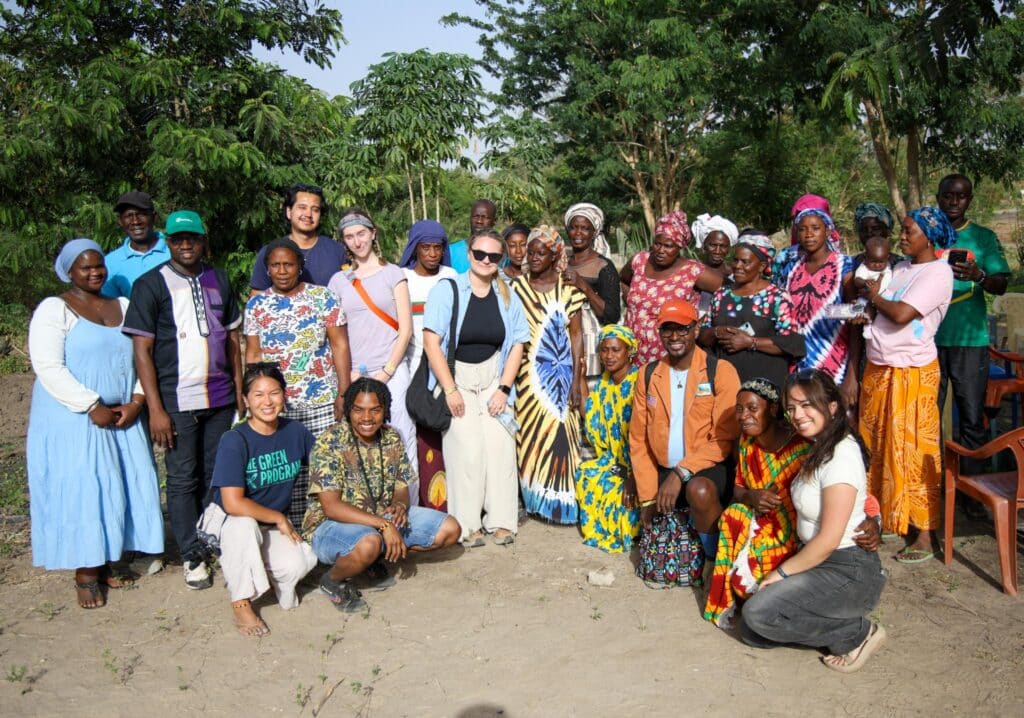
Système Agroforestier Du Village De Keur Sambel Mis En Place Avec L’Appui De L’Association Nebeday, which translates to Agroforestry System of the Village of Keur Sambel Established with the Support of the Nebeday Association, exists as a site resembling women empowerment, sustainable livelihoods, and strategic agricultural development. Agroforestry systems are notable for their deliberate placement of tree species within and throughout a landscape, which provides both shading for low-light plant species and increased groundwater infiltration. The women who care for and produce crop yields through this agricultural site are a testament to self-determination and a willingness to advance quality of life standards. Key observations from the Agroforestry System of the Village of Keur Sambel include the use of solar panels to power water pumps, designation of numerous smaller wells throughout the 1.5 hectare site, use of these smaller water wells to provide a repository for watering cans required to water crops, elevation of a considerably-sized water tower that provides water throughout the site through the forces of gravity, and the existence of a traditional, groundwater well that serves as the primary water source for all distributive and cultivation activities. This site, before the installation of an expansive agroforestry system, was once dominated by the growth of wild peanuts. Now diversified with the production of leafy-green vegetables and fruits, it is an embodiment of its unique character, owned and operated by women – somewhat an anomaly given that land and agricultural operation ownership is customarily a position and responsibility that is assumed by men.
Capstone Project
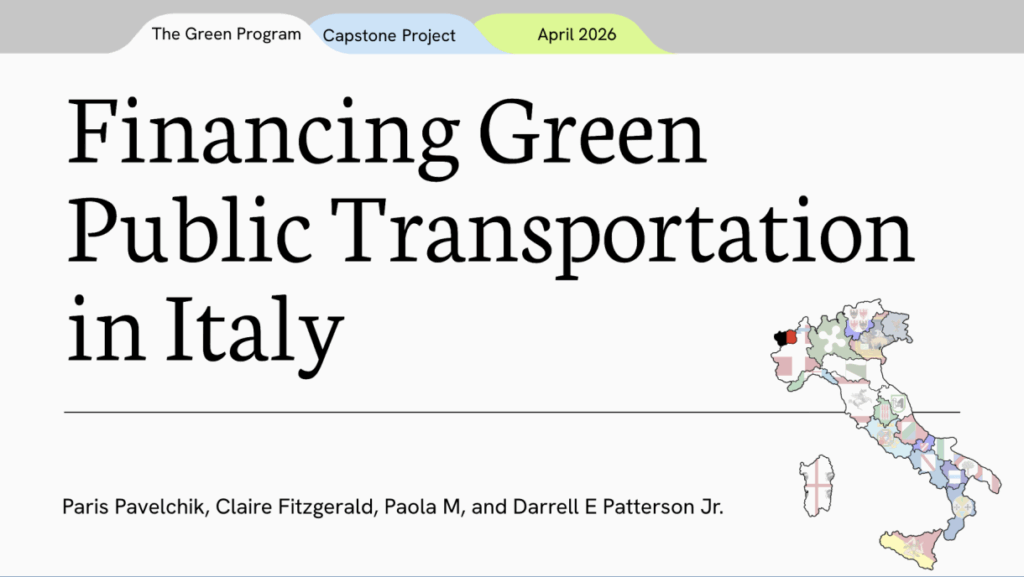
The capstone project that my team and I designed focused on decarbonizing and making more widely available non-vehicular, public transportation systems in Italy. Entitled, “Financing Green Public Transportation in Italy, we worked to conceptually protect Italy’s most vulnerable communities from the impacts of global climate change through decarbonization of existing public transportation assets and infrastructure, and building all-electric transportation systems. To achieve this goal, we devised a green transportation surcharge that exacts $0.10 per fare to and from a destination, to be instituted at every transportation network in Italy. The residual funds from this measure tax would go towards financing and deploying renewable energy projects such as solar and wind, while expanding access to and the expansiveness of Italy’s rail network, which is most critically needed in its southern sections. According to Yoo (2026) “about 30 million people in Italy commute for work or study reasons, with the northern regions registering the highest shares of the commuting population” (Yoo, 2026). The country boasts the largest motorization rate in Europe at an estimated “684 passenger cars per 1000 inhabitants, compared to the European average of 560” (Mazzai, 2024). We are hopeful that this model solution will not only be impactful in Italy, but also serve as a blueprint for municipalities across the world.
Incorporating TGP’s Curriculum into Real-World Contexts
Looking forward, I plan to implement the learnings about climate finance derived from the Investing for a Sustainable Environment online and Climate Finance in Senegal field courses in financial management of my company, Ultra Strata LLC, personal finances and banking, and prospective business opportunities that may arise from the inspiration and guidance provided through my Master of Science in Sustainability Management program at Columbia University. During this spring semester I am currently enrolled in an Accounting, Finance, and Modeling of Sustainable Development course that teaches the fundamentals of how to understand and operate
a balance sheet and interpret, make entries to and calculate formulas within financial statements, identify the time-value of money through simple payback, net-present value (NPV), weighted average cost of capital (WACC), and internal rate of return (IRR), understand the varying capital structures of an organization, how to value a company, and how to model data-driven insights that drive financial decision-making. These skillsets are mission-critical to understand and leverage when presented with real-world business opportunities that stem from The Green Program (TGP)’s field course experience in Senegal, which include possible ventures such as investing in agricultural development amongst smallholder farmers in the country’s agricultural region, recovering and repurposing plastic waste into construction and building materials, and salt mining and distribution in Lac Rose Pink Lake. Most importantly, TGP bridged the connection between economic development and aspects of culture amongst people in Senegal, which is just as important to understand to successfully conduct a multinational business or domestic economic operation.
References
Ahmed, Danish, Hua, Hu X, Bhutta, Umair Saeed (2024). Innovation Through Green Finance:
A Thematic Review. Volume 66. Current Opinion in Environmental Sustainability.
https://doi.org/10.1016/j.cosust.2023.101402
Scheuman, Lindsay Jean (2024). African Baobab Tree: How One Plant Creates An Entire
Habitat. One Earth. https://www.oneearth.org/species-of-the-week-african-baobab-tree/
Yoo, H. (2026). Italy’s Commuting Population – Statistics & Facts. Statista.
https://www.statista.com/topics/6605/italy-s-commuting-population/?srsltid=AfmBOopWDHZo
pZq7qyjvvYOwesd0Ie6DygO5aVTtrU4uBAJCvP9Oy1dM
Mazzai, Alessandra (2024). Electrifying Road Transports in Italy. Foresight.
https://www.climateforesight.eu/articles/electrifying-road-transports-in-italy/